Episode 07: What Media People Are Really Looking For in an Expert
Posted on October 7, 2026 by Rowell Mariano
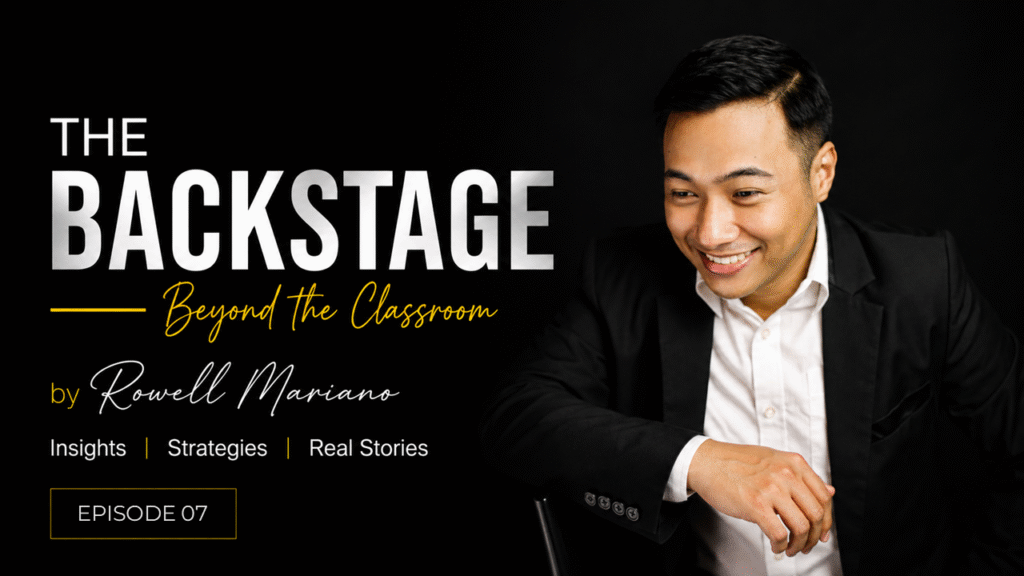
In the previous episode of The Backstage: Beyond the Classroom, we talked about why technical experts sometimes struggle to communicate what they know. We explored how deep expertise does not automatically translate into clear communication, especially when experts speak to people who do not share the same technical background. For this episode, I want to take that conversation one step further. Suppose you already have the expertise and you can communicate it. What happens when the person listening to you is a journalist, producer, editor, columnist, or someone from the media? What are they really looking for when they choose an expert to interview, quote, or feature?
I have been working with people on media communication for more than a decade. I have trained executives, public figures, celebrities, models, pageant candidates, leaders from different organisations, and people in government on how to communicate with the press, respond to interviews, build credibility, and develop better relationships with media. I have also had my own experience being interviewed and working with journalists. But before writing this, I wanted to hear directly from people who actually do the work, so I reached out to friends and contacts from GMA News, ABS-CBN News, showbiz media, newspapers, magazines, and other print and media organisations. Interestingly, although they came from different parts of the industry, many of their answers pointed in the same direction.
Research supports much of what they told me. A systematic review of 90 studies on how journalists seek information found that source selection involves more than expertise alone. Journalists consider factors such as credibility, relevance, accessibility, responsiveness, whether the source can explain complicated information, and whether the information is useful to the story. Journalists also develop longer-term relationships with sources they have found reliable in the past (Hertzum, 2022).
So what are media people really looking for? Based on these conversations, the research, and my own experience, I would organise them into five areas. I call this the MEDIA Framework for a Media-Ready Expert: Match the Story, Expertise That Holds Up, Direct and Understandable, Insight With Substance, and Accessible and Professional.
M: Match the Story
One of the first things I heard from the media people I spoke with was relevance. Are you relevant to the story? Are you relevant to the journalist’s beat? Do you actually have something that will help complete the story they are working on? You may have an impressive title, several degrees, awards, and decades of experience, but if your expertise does not connect with the story, those credentials alone will not make you the right source.
This is why I do not think media people are always looking for the most decorated person. They are looking for somebody who can contribute something useful to the particular story they are developing. There will naturally be situations where credentials become critical. If the story requires a legal interpretation, for example, the journalist may need somebody with the appropriate legal expertise. If the topic concerns a highly specialised technical area, then relevant qualifications and experience become part of establishing authority. But the question remains the same: are you the right person for this particular conversation?
This also connects with how journalists actually look for sources. Research shows that source quality and accessibility influence selection, and relevance is among the qualities journalists consider when evaluating potential sources. Journalists also verify sources through background checks, previous media appearances, online information, and cross-checking with other sources, particularly now that so much sourcing begins online (de Haan et al., 2024).
Your online presence can therefore help, but not simply because you have a lot of followers. If journalists search for your name, what will they find? Does your work show a clear connection to the subject? Have you consistently shared useful thinking about it? Have you actually done the work? The goal is not to look like an expert on everything. It is to make it easier for somebody researching a story to understand what you genuinely know and why your perspective may be relevant.
E: Expertise That Holds Up
Being relevant gets you into consideration, but what you say still has to hold up. Media people know that sources can have agendas, misunderstand a subject, exaggerate, or present themselves as more knowledgeable than they really are. Hertzum’s (2022) review found that journalists pay attention to credibility, accuracy, authority, knowledge, reliability, and prior experience with a source when judging information quality.
One journalist from GMA News told me about a mistake they sometimes see during interviews: people answering a question even when they do not really know the answer. Instead of admitting that they are unsure, they try to produce something because they feel they need to say something. That is risky. If you genuinely do not know, it may be better to say that the question is outside your area, provide only the general point you can responsibly speak about, or tell the journalist that you need to verify the information and come back to them.
Expertise does not mean having an answer to everything. In fact, knowing where your expertise ends can strengthen credibility. Someone who confidently gives unsupported answers may sound impressive for a few minutes, but a journalist can check the information afterwards. Research on online journalistic sourcing shows that journalists use background checks, social media, websites, and cross-checking to verify sources and information (de Haan et al., 2024).
This is also why credentials matter, but they should not become the whole story. A title may help establish why somebody should listen to you, but the value comes from what you can actually contribute.
Credentials can establish authority. Substance has to sustain it.
D: Direct and Understandable
This was probably the most consistent response I received from the media people I asked. Answer the question. Be clear. Get to the point. Someone from GMA News told me that when the interviewee keeps going around the question, the journalist may have to paraphrase and ask it again until they finally get the answer they need. Someone from ABS-CBN News similarly described a useful answer as one that is straight to the point, gives a complete thought, answers the question, and can become a good soundbite.
There is a practical reason for this. The journalist is trying to create a story. They may have interviewed you for twenty minutes, but only a small part of that conversation may eventually appear in the article or broadcast. What they need is an answer they can understand, use, quote accurately, and connect with the rest of the story. This does not mean reducing every complex subject into an oversimplified statement. It means being able to communicate the heart of the idea without requiring the audience to have the same technical background that you have.
This connects directly with what we discussed in Episode 06. Experts sometimes underestimate how difficult their language is for people outside their field. Recent research on expert communication shows that linguistic and content complexity influence how audiences perceive comprehensibility, while research on jargon has found that technical terminology can make explanations harder for non-experts to understand even when the language sounds authoritative (Cruz & Lombrozo, 2025; Taddicken & Thoms, 2025).
When you are talking to a broader public, slow down. Use words people understand. If you need to use a technical term, explain what it means in simple language. Do not use jargon merely to demonstrate that you know the jargon.
Knowing the technical term demonstrates knowledge, but being able to explain the idea simply demonstrates a different level of mastery.
The same principle applies to the length of the answer. One editor and writer I spoke with said that she particularly enjoys interviewing CEOs because many of them have learned how to communicate almost in bullet points. They know the point they want to make and can deliver it without taking unnecessary time. Her frustration comes when somebody keeps talking even when the answer has already moved far away from the original question.
I: Insight With Substance
Being direct does not mean being empty. A ten-second answer can have substance, while a ten-minute answer can say almost nothing. What journalists need is something that contributes to the story. It may be an interpretation, an explanation, an example, a useful fact, a connection that others may not immediately see, or a perspective that helps the audience understand why the issue matters.
One of the people I spoke with described it simply: the source needs to have a story to tell. Even when the statement is short, there should be something in it. The person should not be speaking in a bubble or simply producing words that sound impressive. Another journalist told me that generic, vague, incomplete answers are difficult to use. What becomes quotable is often the answer that contains a complete thought and gives the journalist something memorable.
That does not mean every answer has to become a dramatic quote. It means you should think about what value you are adding. If the journalist removed your comment from the story, what information or insight would be lost? That is a useful question for any expert who wants to become a better media source.
This also explains why authenticity and personality matter. The ABS-CBN News journalist I spoke with mentioned that interesting answers and authentic personality can make an interview more useful. Demeanour matters too. Confidence can reinforce the impression that the person understands the subject, although confidence should never become a substitute for accuracy. The strongest combination is when confidence is supported by actual knowledge and the answer itself gives the audience something worth remembering.
There is also an important difference between having a strong point of view and exaggerating. Media people are trained to listen, question, compare, and look for inconsistencies. If you keep overstating things simply because you want a more dramatic soundbite, that may eventually work against you.
Media people do not need long answers. They need answers with something in them.
A: Accessible and Professional
Expertise may get you interviewed once. How you work with media people can influence whether they want to call you again. Journalism often operates on tight deadlines, so accessibility and responsiveness matter. Hertzum’s (2022) systematic review found that accessibility factors such as responsiveness, availability, the ability to provide digestible information, and familiarity with the source influence journalists’ source selection. It also found that journalists cultivate long-term relationships with selected sources.
This is something I take seriously in my own relationships with the press. I take care of those relationships because media people also invest time and effort. They research, coordinate, follow up, interview, write, edit, and work against deadlines. Building a relationship with them does not mean flattering them or expecting them to write something favourable about you. It means treating them properly, respecting their work, being responsive, being prepared, and being somebody they know they can deal with professionally.
A veteran showbiz columnist I spoke with described how trust had allowed that person to maintain relationships with celebrities and industry figures over several decades. Respect was central to that relationship. There were conversations where the source was willing to answer questions, and there were situations where certain ground rules had to be respected. Different journalists and organisations can define terms such as “off the record” differently, which is why those expectations should be clarified before sensitive information is shared. The Associated Press similarly advises reporters and sources to make ground rules explicit because not everyone uses those terms in exactly the same way.
The larger lesson is that media relations should not be built on control. A journalist is not there to become your publicist. Their responsibility is to their story and their audience. You can build trust, answer honestly, clarify facts, and develop professional relationships, but you should not assume that a good relationship gives you the right to dictate the final story.
Research on journalist-source relationships also shows why this balance matters. Professional relationships between journalists and sources involve trust, but journalists simultaneously maintain boundaries and editorial autonomy. Those relationships have to accommodate both familiarity and professional distance (Malling, 2024).
This is why one of the biggest mistakes an expert can make is to treat the media as an enemy from the beginning. Being interviewed does not mean surrendering your boundaries, and not every media experience will be positive. There may be difficult questions, uncomfortable angles, or stories you do not necessarily like. But entering every interaction with hostility, arrogance, or suspicion also makes it harder to have a productive professional relationship. You can be careful without being combative, and you can protect your credibility without trying to control the journalist.
The MEDIA Framework for a Media-Ready Expert
When I bring all these conversations together, I see five areas that experts can think about before facing the media. Match the Story means understanding whether your expertise is genuinely relevant to what the journalist is working on. Expertise That Holds Up means having a credible basis for what you say and being willing to acknowledge what you do not know. Direct and Understandable means answering the actual question and translating complex ideas into language a broader audience can follow. Insight With Substance means contributing something that strengthens the story rather than simply filling airtime. Accessible and Professional means being responsive, prepared, respectful, and capable of building professional relationships over time.
The MEDIA Framework does not guarantee coverage, and it certainly does not guarantee that every journalist will use your interview exactly the way you imagined. That is not the point. The purpose is to help an expert become a stronger source. You want to become the person a journalist can call because you are relevant, credible, understandable, useful, and professional.
Perhaps that is also the difference between being interviewed once and becoming somebody the media remembers. Being an expert can get you considered. Being media-ready can give people a reason to call you again.
Media Readiness Can Be Developed
Not everyone begins naturally comfortable in front of a camera, answering difficult questions, or speaking within the limited time available for an interview. Some people know their subject extremely well but become nervous when the camera turns on. Others give very long answers because they want to make sure every technical detail is included. Some answer questions they should not answer because they are afraid that saying “I don’t know” will make them look less credible.
These are skills that can be developed. For more than a decade, I have personally worked with different types of people on media communication, including executives, public figures, celebrities, models, pageant candidates, and leaders from both business and public institutions. The work can include preparing for interviews, organising thoughts, handling difficult questions, improving delivery, understanding how media works, building credibility, and developing more professional relationships with journalists.
At Talent Academy International, this is also part of the capability we can help develop. Media training should not be about teaching somebody to memorise scripted responses or avoid every difficult question. The stronger objective is to help people understand their message, organise their thinking, speak with credibility, answer clearly, and remain themselves while doing it. We also support organisations in preparing for press engagements and press conferences where leaders may need to communicate clearly under public scrutiny.
A technically perfect answer that nobody understands is not useful. A memorable soundbite with no substance is not much better. Media readiness happens when expertise and communication come together in a way that gives the story and the audience something of value.
Before You Say Yes to the Next Interview
The next time somebody from the media calls, perhaps the first question should not be, “How do I make myself look good?” A better starting point may be, “What is the story, and what can I genuinely contribute to it?” Once that is clear, the rest becomes easier. Know what you know, answer the question, explain it simply, give something useful, and treat the people you are working with professionally.
The media may be the channel through which thousands or even millions of people encounter your expertise for the first time. What they remember may not be your full résumé or every qualification beside your name. They may remember the one explanation that finally made a complicated issue understandable, the one insight that helped complete the story, or simply that you were someone worth calling again.
And sometimes, becoming visible as an expert is not about saying more. It is about knowing what is worth saying when the opportunity comes, in the backstage, beyond the classroom.
References
Cruz, F., & Lombrozo, T. (2025). How laypeople evaluate scientific explanations containing jargon. Nature Human Behaviour, 9(10), 2038–2053. https://doi.org/10.1038/s41562-025-02227-0
de Haan, Y., Kruikemeier, S., & Lecheler, S. (2024). Searching, selecting, and verifying: Online journalistic sourcing strategies. Tijdschrift voor Communicatiewetenschap, 52(2), 150–176. https://doi.org/10.5117/tCW2024.X.001.hAAN
Hertzum, M. (2022). How do journalists seek information from sources? A systematic review. Information Processing & Management, 59(6), 103087. https://doi.org/10.1016/j.ipm.2022.103087
Malling, M. (2024). How the social complements, extends or replaces the professional: Autonomy and adaptation in journalist-source relationships. Journalism Practice, 18(9), 2206–2223. https://doi.org/10.1080/17512786.2024.2313148
Taddicken, M., & Thoms, C. (2025). How comprehensible are scientific experts? A multi-method comparison of linguistic analyses, surveys, and real-time audience responses. Frontiers in Communication, 10, 1580377. https://doi.org/10.3389/fcomm.2025.1580377