Episode 10: Should Every Expert Write a Book?
Posted on October 28, 2026 by Rowell Mariano
As I write this, I am in the United States attending the IACET Commissioners Assembly and Training in St. Louis, Missouri. Before coming here, I spent some time in Los Angeles visiting relatives and friends. Somewhere between airports, aircraft seats, conversations, and moving from one place to another, an idea started forming in my head. I thought of something I wanted to share, so I started writing.
What am I writing? That is something you will find out soon.
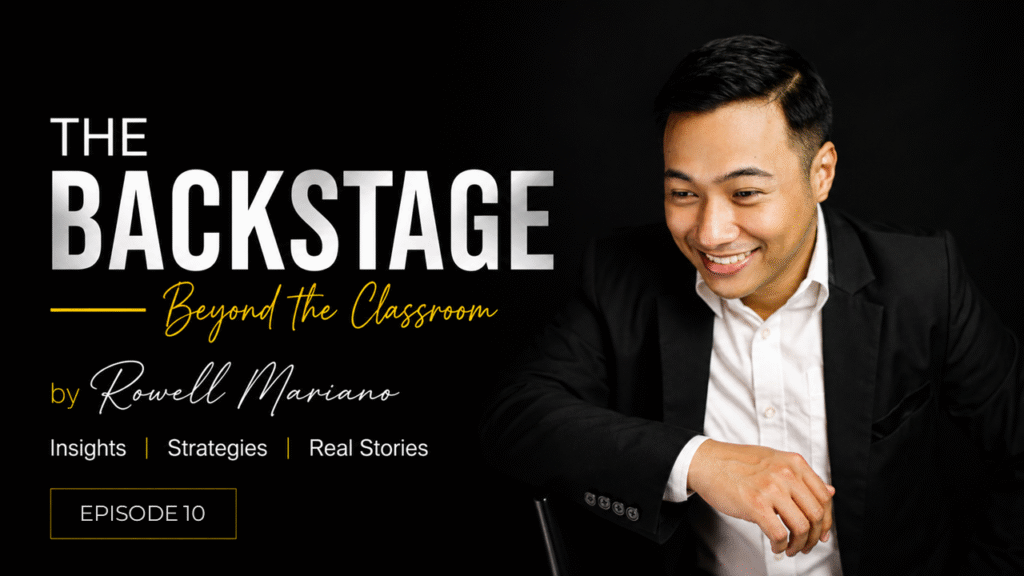
But that moment made me think about this episode of The Backstage: Beyond the Classroom. We are already on Episode 10, and throughout this series, I have been sharing ideas, experiences, frameworks, mistakes, and lessons from years of working in talent development, learning excellence, leadership, accreditation, communication, and thought leadership. In Episode 09, we talked about why leadership development has a transfer problem. This time, I want to go deeper into thought leadership and credibility by asking a question that has become very personal to me.
Should every expert write a book?
My answer is yes.
Not because everybody needs the title “author.” Not because having a book automatically makes someone important. And certainly not because we need more books containing information that people can already find anywhere.
I believe experts should write because expertise carries a responsibility to contribute.
The Book I Was Encouraged to Write for Years
I did not wake up one morning and suddenly decide that I wanted to become an author.
More than a decade ago, my good friend Pido Aguilar, may he rest in peace, was one of the first people who encouraged me to write a book. Later, another good friend, Melody Llona, who was already a textbook author whose work was being used in academia, told me the same thing. Other friends and colleagues in the industry also encouraged me because they knew how much of my professional life had been spent doing training and talent development end to end.
By then, I had also served for years as a Board of Trustee of the Philippine Society for Talent Development. I had learned the profession not simply through books and courses, but by doing the work, making mistakes, designing programs, facilitating, managing learning, working with organisations, and seeing what worked and what did not.
Still, I did not immediately write the book.
Then, around February 2020, Lloyd Luna gave me a copy of one of his books. There was a challenge that came with it: I should write my own.
I accepted.
But the real reason I eventually wrote Will It FIT? A Guide for Training Professionals and Enthusiasts was not simply because somebody challenged me. I remembered what it felt like when I was beginning my journey in training. I knew very little about the profession. I had to learn many things along the way, sometimes the difficult way. I knew there were people entering the same profession who might be experiencing exactly what I had experienced.
I thought, if I already learned some of these things, why should the next person have to struggle in exactly the same way?
That became the purpose of the book.
The title Will It FIT? came from questions that matter in our profession. Management might ask whether a learning intervention will fit the needs of the business. A talent development professional might ask whether it will fit the needs of the people and the organisation. Behind those questions is the need to create learning that actually makes sense for the context in which it will be used (Mariano, 2022).
I did not write the book because I wanted people to know that I was an author. I wrote it because I wanted what I had learned to become useful to somebody else.
Yes, Experts Should Write, But There Is a Condition
I still believe every genuine expert should consider writing a book, whether you have been practising your profession for many years or you are relatively new but have developed something useful worth sharing.
There is a condition, though.
You need to have something to contribute.
Being in an industry for 20 years does not automatically mean that your next step should be collecting information that is already available everywhere and putting your name on the cover. Years of experience should have given you something more than information. They should have given you perspective.
Perhaps you have discovered a faster or simpler way to do something complicated. Perhaps you have created a framework after repeatedly solving the same problem. Perhaps you have learned why a commonly accepted practice does not always work. Perhaps you have developed shortcuts, techniques, questions, processes, or ways of explaining something that make it easier for other people to understand.
That is where your contribution begins.
This does not mean every book needs to contain a revolutionary discovery that nobody in history has ever considered. Originality can also come from how an expert synthesises existing knowledge, connects it to practice, gives it structure, interprets it differently, or makes a complicated subject more useful to a particular audience. Research on thought leadership similarly emphasises distinctiveness, evidence, quality, uniqueness, reach, and trust rather than simply producing more content (Anderson & Marshall, 2025).
A book does not have to contain something nobody has ever said before. But it should contain something the reader could not have received in exactly the same way without you.
Your Expertise Should Not Leave With You
There is another reason I believe experts should write.
A book is also a legacy.
One day, all of us will leave our positions. Eventually, we will leave our professions. And at some point, we will no longer be here. If everything we learned remains only in our heads, much of it can disappear with us.
Research on knowledge retention has long recognised this problem. When experienced people leave organisations, valuable knowledge can leave with them. Knowledge codification is one way of preserving and sharing learning beyond the individual who originally developed it, although not every form of tacit expertise can be completely captured in writing (Burmeister & Deller, 2016; Ferres & Moehler, 2024). Codified knowledge can also travel beyond the time, place, project, or organisation in which it originated.
A book cannot capture everything you know. No book can completely reproduce decades of intuition, judgment, relationships, mistakes, and experience.
But it can preserve something.
That book can remain on somebody’s shelf long after you have retired. Someone you will never meet may read it years from now. A student may use it as a reference. A practitioner may apply one of your ideas. Another expert may challenge your framework, improve it, or build something new from it.
In that sense, writing places part of your thinking into the record. You are contributing something that can outlive your job title, your current organisation, and eventually even you.
That is why I do not see authorship simply as another credential. It is one way of leaving knowledge behind.
The SHARE Framework for Expert Authorship
After writing my own book, working on another book as Project Editor and co-author, and continuing to write articles like The Backstage, I have come to think of expert authorship through five areas. I call this the SHARE Framework for Expert Authorship: Substance Worth Sharing, Have a Clear Reader, Authentic Ideas From Practice, Responsibility to the Reader, and Extend the Impact.
The name is intentional because, ultimately, that is what expert authorship should be about. You are taking something you have learned and making it available to other people.
S: Substance Worth Sharing
Before asking how to publish a book, ask a more difficult question: What do I actually have to say?
Your core idea matters.
What have you learned that other people could benefit from? What problem have you learned to solve differently? What mistake did you make that someone else does not have to repeat? What process have you improved? What framework have you developed? What have years of practice taught you that someone cannot simply understand by reading a definition?
If you cannot answer those questions yet, perhaps you are not ready to write the book yet. That is fine. It means you need to think more deeply about your contribution first.
We already have enormous amounts of information around us. An expert’s job should not simply be to add another layer of generic information. It should be to contribute perspective, experience, interpretation, evidence, or application.
This is also how I approach The Backstage. The subjects I discuss here are not topics that nobody has ever talked about. Learning culture, leadership development, thought leadership, accreditation, communication, and learning quality all have existing bodies of knowledge. What I try to contribute are insights from actual practice, questions that experience has taught me to ask, and frameworks that help organise those ideas in a way that may be useful to someone else.
A book should add something to the body of knowledge, not simply add more pages to what is already available.
H: Have a Clear Reader
Once you know what you want to contribute, the next question is: Who needs it?
When I wrote Will It FIT?, saying that the book was “about training” would not have been enough. Training is an enormous subject. I needed to think about who would actually read it.
I thought about people beginning their journey in training and talent development. I also thought about practitioners who had already been doing the work but still struggled with some of its foundations, processes, and standards.
Once the reader became clearer, many other decisions became easier.
How technical should the book be? What examples should I use? What language should I speak? What should I explain from the beginning? What could I assume the reader already knows? Which struggles would they recognise? Which questions were they probably asking?
If you say that your book is for “everyone,” I would still ask you to go deeper. Everyone who? What do these people have in common? Why would they choose your book?
The clearer the reader, the clearer the book.
A book can begin with something you want to say, but it becomes useful when you understand who needs to hear it.
A: Authentic Ideas From Practice
The next part is authenticity.
Your book should sound like you. More importantly, it should think like you.
There is nothing wrong with getting help. Authors work with editors, researchers, proofreaders, designers, publishers, and other professionals. Someone can help you make your writing clearer. Someone can question your structure. An editor can tell you that a chapter is confusing or that an argument needs more evidence.
But the thinking that makes the book yours cannot simply be outsourced.
The stories should mean something to you. The frameworks should reflect how you understand the subject. The experiences should come from something you genuinely know. If you are teaching a method, ideally you should be able to explain how you have used it, what happened, where it worked, where it did not, and what you learned.
This is where cases become powerful. If you are writing about recruitment, what have you actually experienced in recruiting people? If you are writing about leadership, what have you learned from leading or developing leaders? If you developed a framework, where has it been applied? What did application teach you that theory alone could not?
Research on thought leadership makes a similar distinction between generic content and distinctive, evidence-based perspectives. Authority is strengthened when a point of view combines expertise with substance rather than merely repeating familiar messages (Anderson & Marshall, 2025).
If your name is on the cover, your thinking should be inside the pages.
R: Responsibility to the Reader
Writing a book is not only self-expression. It comes with responsibility, particularly when you are writing nonfiction and asking people to learn from you.
Facts need to be checked. Other people’s ideas need to be properly attributed. Sources need to be cited. If you are introducing your own framework, be clear that it is yours rather than presenting it as established research. If you are offering an opinion based on experience, do not disguise it as universal truth.
The reader has chosen to give you something valuable: attention and, to some degree, trust.
You need to respect that.
This is also where I draw the line between contribution and vanity. Wanting to become an author is not wrong. Wanting stronger credibility is not wrong. Wanting business opportunities is not wrong. Wanting people to buy your book is certainly not wrong.
The problem begins when the book exists mainly so that the author can say, “Look at me.”
Even a personal story can be valuable. A memoir can teach, challenge, inspire, preserve history, or help readers understand an experience they have never lived themselves. The problem is not writing about yourself. The question is what the reader receives from your story.
You can talk about achievements, failures, awards, opportunities, mistakes, and milestones. But there should be a reason for telling them beyond self-promotion.
Personal story is not vanity. Personal story without contribution can become vanity.
That is why I see authorship as a responsibility. Writing a book is not only an act of expression. It is an act of responsibility to the person who chooses to believe what you wrote.
E: Extend the Impact
Once the book exists, its contribution does not have to stop on the page.
A good book can lead to conversations. Those conversations can become speaking engagements, training programs, workshops, consulting assignments, interviews, collaborations, research, articles, or new ideas.
That is not something authors should be embarrassed about.
After Will It FIT?, being an author became another piece of evidence of my expertise in training and talent development. It did not create my entire professional journey, and I would never claim that a book alone made me an expert. But it strengthened my professional positioning. It supported speaking, training, consulting, interviews, and other opportunities because people could see something concrete that represented how I thought about my profession.
Later, I also served as Project Editor and co-author of the first-ever book of the Philippine Society for Talent Development. That experience allowed me to see book development much more end to end. I have also been invited by Dr. William Rothwell to collaborate with other authors from different countries on a book related to talent acquisition. Those opportunities remind me that one contribution can sometimes lead to another.
Research on professional positioning also suggests that differentiation and recognition are important dimensions of personal brand equity. A book is not automatically a strong professional brand, but a credible body of published work can become one way an expert makes their expertise more visible and distinguishable (Szántó et al., 2025). DOI
And yes, a book can also make money.
People can buy the book. Organisations may purchase copies. The author may earn royalties or direct income. But there is another form of business value as well. Someone can read your book, understand your expertise, and decide to invite you to speak, train, consult, collaborate, or work with them.
I think of those as two different forms of return. People can buy your book, and sometimes your book can give people a reason to buy into your expertise.
But the order matters.
A book should not be your sales brochure. It should be evidence of why someone might want to work with you.
The business value becomes much stronger when there was intellectual value first.
Writing the Manuscript Is Not the Whole Job
There is also something aspiring authors do not always see.
Writing is only one part of producing a book.
Before I wrote my first book, I also thought about how much I would have to write. A book can look intimidating when you imagine thousands and thousands of words before you have even started.
But writing became easier when I stopped thinking first about the number of pages and focused on the core idea. What do I want to say? What is the structure? What are the thoughts I need to get out?
Then write.
Sometimes I free-write first. I put ideas down without immediately worrying about whether every paragraph belongs in the final manuscript. Later, I organise them. I read them again and again. I move things around. I remove what does not belong. I add what is missing. Eventually, you begin to find what I call the sweet spot of the book.
But finishing the manuscript does not mean the book is finished.
There is editing. Rewriting. Fact-checking. Reference checking. Sequencing. Layout. Design. Proofing. Back-and-forth revisions. Coordination with publishers or printers. The final look and feel. Then there is production.
And after the book is produced, there is another stage: getting it to readers. There may be a book launch, promotion, distribution, speaking about it, and finding ways for the people you wrote it for to actually discover it.
My experience as Project Editor reinforced this even more. Readers see the final pages. They rarely see all the decisions, corrections, revisions, coordination, checking, and rechecking behind those pages.
Writing gives you the manuscript. Publishing turns the manuscript into a book.
Your Book Is Evidence, Not a Substitute for Expertise
There is one more distinction worth making.
Having “author” beside your name can certainly influence how people perceive you. But publishing a book does not automatically make every claim you make credible.
Credibility still has to hold up.
If you are a CPA who has built substantial experience in accounting, writes a rigorous accounting book, and that book eventually becomes useful to professors, students, examinees, and practitioners, the book can help establish your influence beyond your own workplace. People begin encountering your thinking even if they have never worked with you directly.
That is powerful.
A book allows your expertise to travel to rooms you may never personally enter.
But what happens when the book reaches those rooms depends on what is inside it.
That is why I would distinguish the signal from the substance. “Author” may make someone curious about you. The quality of your thinking determines whether that curiosity becomes credibility.
Being published may get people’s attention. What you publish determines whether you deserve their trust.
This distinction also matters in thought leadership. Anderson and Marshall (2025) highlight uniqueness and trust among the attributes associated with high-value thought leadership, while research on personal branding points to differentiation and recognition as important components of professional positioning (Szántó et al., 2025). The common thread is that visibility alone is not enough. There needs to be something substantive behind what people see.
Do Not Wait for the Perfect Outline
What would I tell someone who has been saying for years, “Someday, I will write a book”?
I would tell them to start writing.
You do not necessarily need the perfect table of contents today. If your idea already follows a clear process or sequence, outlining first can help. Build the chapters, define the flow, and begin filling them in.
But if you have many ideas and you are afraid that creating a rigid structure too early will limit them, then write first.
Put the thoughts down.
Write the story. Write the framework. Write the lesson you learned from that difficult client. Write the mistake you made ten years ago. Write the approach you developed because the usual method did not work. Write the explanation you have given so many times that you now know exactly how to make people understand it.
Once you have 5,000 words, then 10,000, patterns begin to appear. You start recognising what belongs together. Chapters begin forming. You discover gaps. You see what needs more research and what needs to be removed.
Structure can follow thinking.
Before you start, though, I would still ask a few fundamental questions: What is the central idea? Who are you writing for? What will they find in your book that they cannot get from a basic search? What have you actually experienced or applied? What problem are you helping them solve? What is uniquely yours in the way you are telling this story?
Then begin.
Because eventually, no amount of thinking about writing substitutes for writing.
A Book Is Something You Leave Behind
The more I think about this episode, the more I realise that the biggest reason I believe experts should write is not credibility, positioning, or even business.
Those matter. I have experienced their benefits myself.
But there is something bigger.
We spend years learning our professions. We make mistakes. We solve problems. We develop judgment. We discover easier ways to explain difficult things. We create tools. We test ideas. We learn from people. Sometimes we spend decades building expertise that exists largely in our heads.
Then what?
Knowledge-preservation research reminds us that valuable expertise can disappear when experienced people leave unless some of that knowledge is deliberately captured and shared (Burmeister & Deller, 2016; Ferres & Moehler, 2024). A book is certainly not the only way to preserve knowledge, but it is one enduring way of making part of what we know available beyond ourselves.
Your book can outlive your position. It can outlive the organisation you currently work for. It can even outlive you.
Perhaps someone will read it years from now and learn something that saves them from a mistake you once made. Perhaps a student will cite it. Perhaps another professional will build on your idea. Perhaps somebody will disagree with you and develop a better framework because your book gave them something worth challenging.
That is also contribution.
In a small but meaningful way, you are putting part of your thinking into history.
So, should every expert write a book?
I still say yes.
But do not write merely so you can call yourself an author. Have something worth sharing. Know who you are sharing it with. Make sure the thinking is genuinely yours. Take responsibility for what you put into the world. Then allow that contribution to travel further than you can.
And if you already know there is a book somewhere inside everything you have learned, stop waiting for someday.
The way to start writing a book is to start writing.
Because some of the most valuable work an expert can do happens when what they know no longer stays only with them. And that, too, is part of what happens in the backstage, beyond the classroom.
References
Anderson, C. W., & Marshall, A. (2025). Thought leadership: Maximizing impact through distinctive voice and authoritative points of view. Leader to Leader, 2025(117), 65–71. DOI: 10.1002/ltl.20903
Burmeister, A., & Deller, J. (2016). Knowledge retention from older and retiring workers: What do we know, and where do we go from here? Work, Aging and Retirement, 2(2), 87–104. DOI: 10.1093/workar/waw002
Ferres, G. M., & Moehler, R. C. (2024). Running the codification gauntlet: Why intent alone cannot afford the codification of project learnings. Project Management Journal, 55(4), 406–422. DOI: 10.1177/87569728241227558
Mariano, R. V. (2022). Will It FIT? A guide for training professionals and enthusiasts. Rex Printing Company, Inc.
Szántó, P., Papp-Váry, Á., & Radácsi, L. (2025). Research gap in personal branding: Understanding and quantifying personal branding by developing a standardized framework for personal brand equity measurement. Administrative Sciences, 15(4), 148. DOI: 10.3390/admsci15040148